When OpenAI cut the price of GPT-5.6 Luna by 80%, my first thought was pretty straightforward: running background AI agents just became much cheaper.
The second thought came later. Maybe this is about more than API pricing. OpenAI seems to be trying to make itself so cheap and accessible that its models quietly become part of research, business, and everyday life.
I checked the numbers and technical claims against OpenAI's own publications. The main sources are its posts about the GPT-5.6 price cut, the GPT-5.6 model family, the engineering behind the efficiency gains, and the free program for academic researchers.
Luna's new API price is $0.20 per million input tokens and $1.20 per million output tokens. OpenAI says the price fell by 80%. The company is also talking more about cost per successful task rather than token prices alone.
That makes sense. If a cheap model needs three attempts, burns through a huge amount of tokens, or hands back work that a person has to repair, it was not actually cheap. At the same time, not every step needs the best available model. A clearly scoped background task may work just as well on something smaller.
This is why I do not use one model for everything.
Alongside the price cuts, OpenAI announced that it will give 100,000 scientists, mathematicians, and engineers free access to its frontier models. The first 10,000 participants are due to join in summer 2026, with the program expanding through 2027.
This is not simply a bundle of free API tokens. Participants get access to ChatGPT, ChatGPT Work, Codex, and the GPT-5.6 family, along with higher usage limits and larger context windows. OpenAI says it will commit more than $250 million to external scientific research and discovery through 2027.
According to the company, about 1.3 million people use ChatGPT for advanced science and mathematics every week. Free access is good news for researchers, but it is also a very strong distribution strategy.
If a researcher starts using the same system for literature reviews, hypotheses, code, data analysis, and grant applications, the service stops being one tool among many. Workflows, training, integrations, and internal institutional habits grow around it. Switching later means much more than selecting another model in a settings menu.
My reading is that the Luna price cut and free access for researchers are two parts of the same strategy. OpenAI is trying to make adoption so cheap and easy that its models become part of daily processes before people even think of them as infrastructure.
Hermes is an AI agent running on my own computer. It is more than a chat window. It can read files, use a browser, run commands, verify results, and split a job into smaller pieces.
I use GPT-5.6 Sol as the main model. It keeps track of the larger goal, decides what needs to happen, and checks the final result. Sol is expensive compared with smaller models, so I do not want it reading every long document or handling every mechanical intermediate step itself.
When a task can be split, Hermes delegates parts of it to isolated subagents. Each subagent receives a limited task and its own context. It works separately, then returns a compact result to the main agent. Sol can spend its tokens on decisions instead of chewing through every piece of raw material.
My current routing looks like this:
In theory, OpenAI's own model family could cover the whole route: Sol for difficult work, Terra for the middle, and Luna for cheap volume. In my setup, DeepSeek still fills much of the text role that Terra and Luna otherwise would. DeepSeek V4 Flash costs $0.28 per million output tokens, compared with Luna at $1.20. I did not move every background job to Luna simply because OpenAI lowered the price.
I use Claude differently. It is not permanently on the main route. I bring it in as a second pair of eyes when I want to review a code change, hunt down a difficult bug, or inspect something related to security. A check from a different model family is useful precisely because it may not make the same assumptions as the model that did the first pass.
I wanted to compare Luna with a local model using an actual measurement. I ran Qwen 3.6 27B on my RTX 4070 Ti SUPER. In a 1,000-token test it generated an average of 36.85 tokens per second, while the GPU drew an average of 273 watts.
If I add an estimated 80 watts for the rest of the computer and use an all-in electricity price of €0.2246 per kWh, generating one million output tokens costs about €0.60. At the ECB exchange rate on 30 July 2026, one million Luna output tokens cost about €1.05.
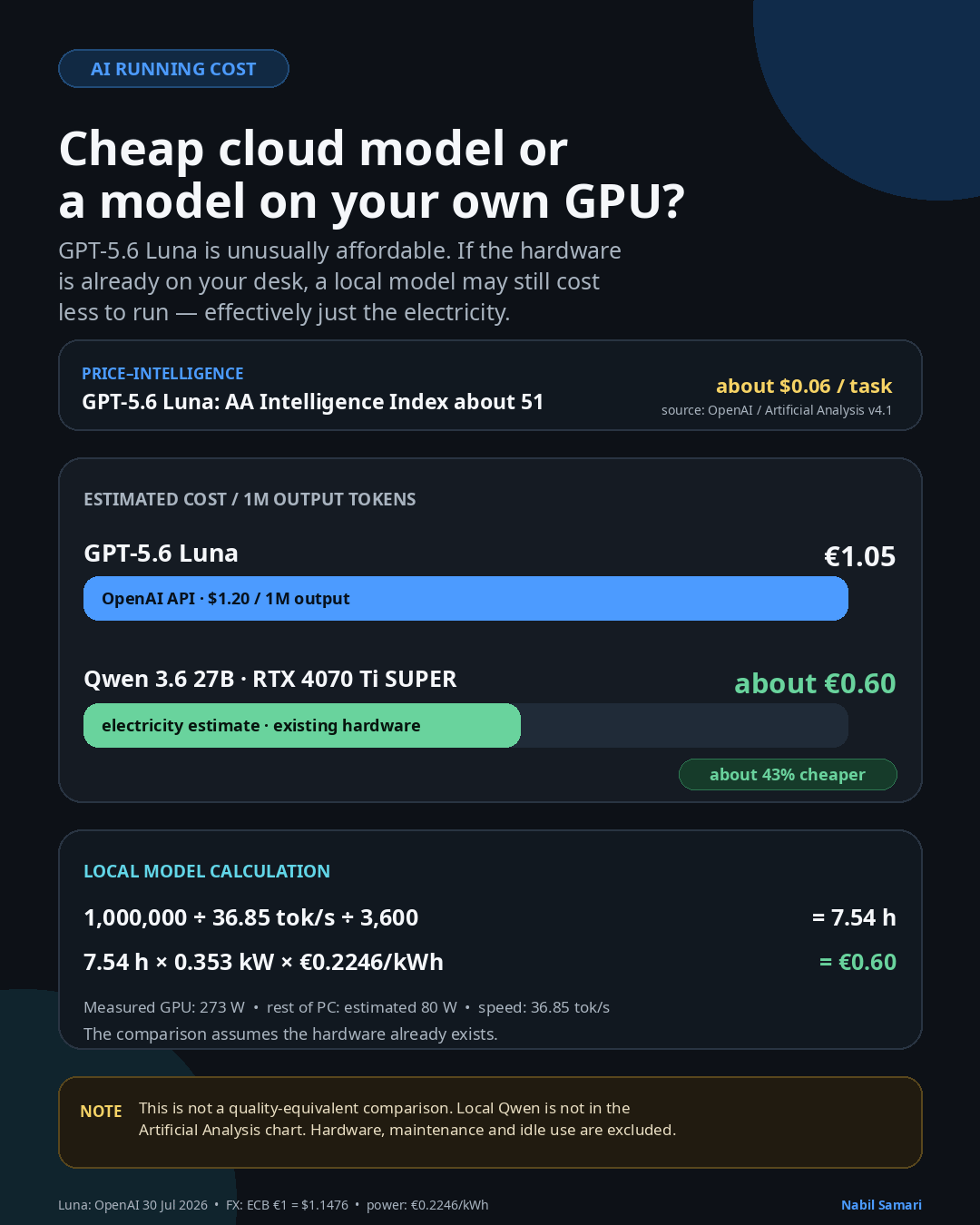
Measured on my own computer. The local estimate includes measured GPU power and an 80-watt allowance for the rest of the system. It does not include the purchase price of the hardware.
The local run was about 43% cheaper in this calculation. That does not mean Qwen and Luna offer equivalent quality. This comparison only covers running cost when the hardware already exists. The GPU purchase, depreciation, maintenance, and idle power are outside the calculation.
This is exactly why routing interests me more than finding one winning model. A local model makes sense when the job is private and repetitive, and a good enough local model exists. A cloud model wins when I need stronger reasoning, vision, tool use, or ready-made infrastructure without maintaining the machine myself.
One section in OpenAI's engineering post stayed with me. The company says Sol rewrote and optimized production kernels, designed hundreds of experiments to improve token generation, and monitored training while responding to problems.
According to OpenAI, the kernel work reduced end-to-end serving costs by 20%. Changes to speculative decoding improved token-generation efficiency by more than 15%.
This should not be inflated into a story about a fully independent AI improving itself without people. OpenAI describes a human-led process, and production work is verified. The direction is still interesting. A better model helps make the next model cycle and the infrastructure beneath it cheaper. Some of those savings come back to users through lower prices. Lower prices create more usage and more reasons to embed the model inside new services.
The Luna price cut, the researcher program, and Sol's work on infrastructure optimization all point in the same direction. OpenAI is trying to become a general AI layer for society. ChatGPT carries it into everyday life, while Codex, tools, and agents carry the same technology into software development and internal business processes.
A cheap Luna fits that strategy. When a capable model costs very little, it can run behind thousands of small workflow steps. The user may not even know when a model is classifying, checking, searching, or summarizing something for them.
My answer is not to choose one provider for everything. I would rather build a system that selects the right route for the job. A difficult decision goes to Sol. Cheap text work goes to DeepSeek. Images go to Luna. An extra bug or security review goes to Claude. Private and repetitive work goes to local Qwen.
That lets me use better and cheaper models without locking my entire way of working inside one company.
OpenAI wants to be everywhere. That can be genuinely useful for users. I still want to decide which parts of my work pass through it.