Impressive demos tend to get most of the attention when a new AI model launches. I'm also interested in which tasks are worth giving it and how much time I'll still spend checking its work.
Anthropic released Claude Fable 5.2 and Mythos 5.2 on November 9, 2026, for demanding technical work. Fable and Mythos share the same underlying model, but their access restrictions and availability differ. Mythos is available to approved organizations for uses such as cybersecurity and the life sciences. Anthropic's announcement.
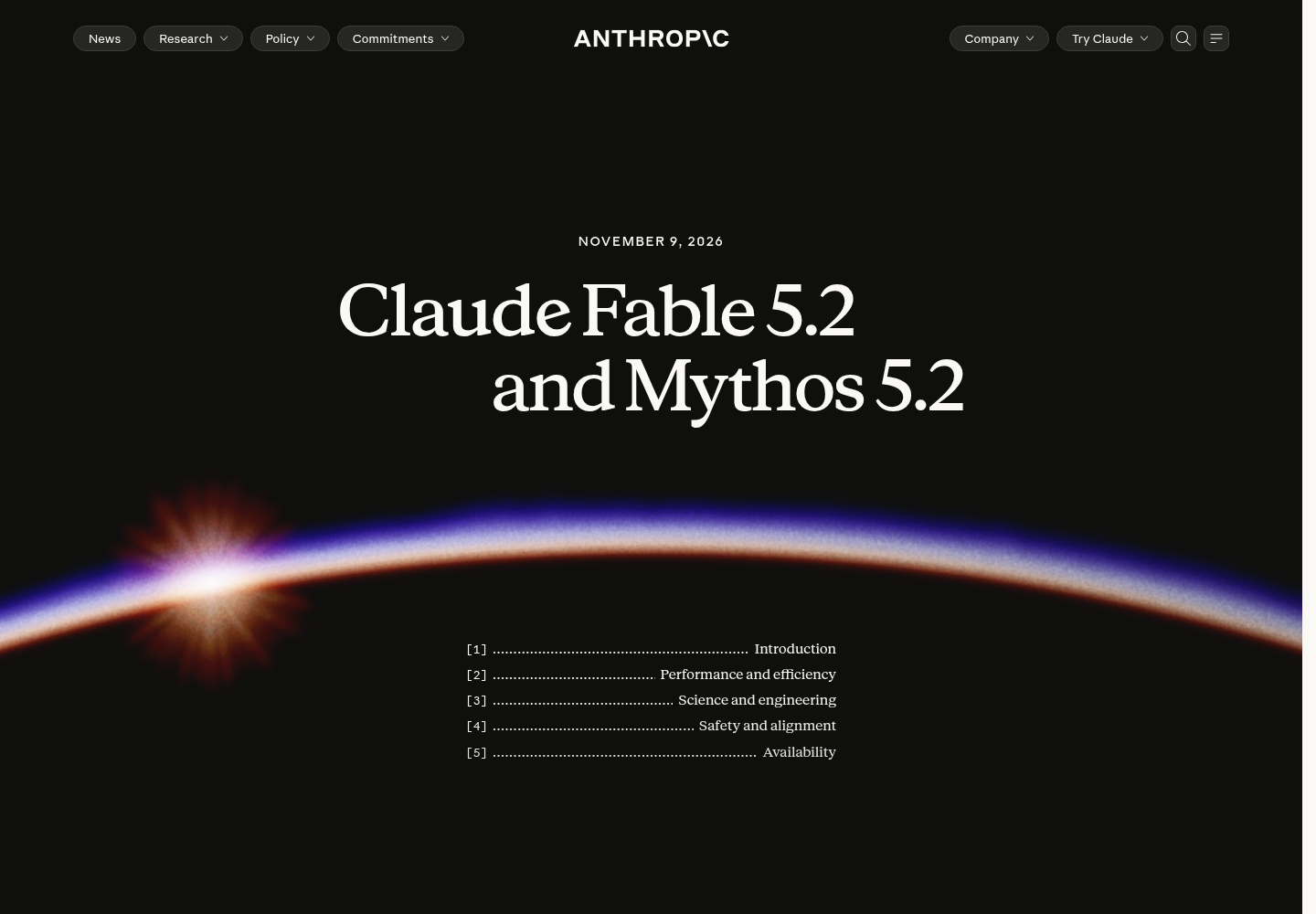
Anthropic's announcement page. Screenshot taken November 11, 2026. Source.
Faster output and new pricing
According to Anthropic, Fable 5.2 generates output tokens up to 30 percent faster than 5.1. Fast mode can generate tokens at up to 2.5 times the speed of standard mode. Release speed figures.
Token speed measures something different from the time needed to finish a task. Fixing a website also involves reading files, using tools, and testing. A response that appears quickly may still contain a change you need to fix.
The base API prices at launch are:
| Mode | Per million input tokens | Per million output tokens |
|---|---|---|
| Standard | USD 8 | USD 40 |
| Fast | USD 16 | USD 80 |
These prices apply to API use. Claude subscription limits are separate, and caching and batch processing have their own pricing. Model specifications and pricing, Fast mode launch pricing.
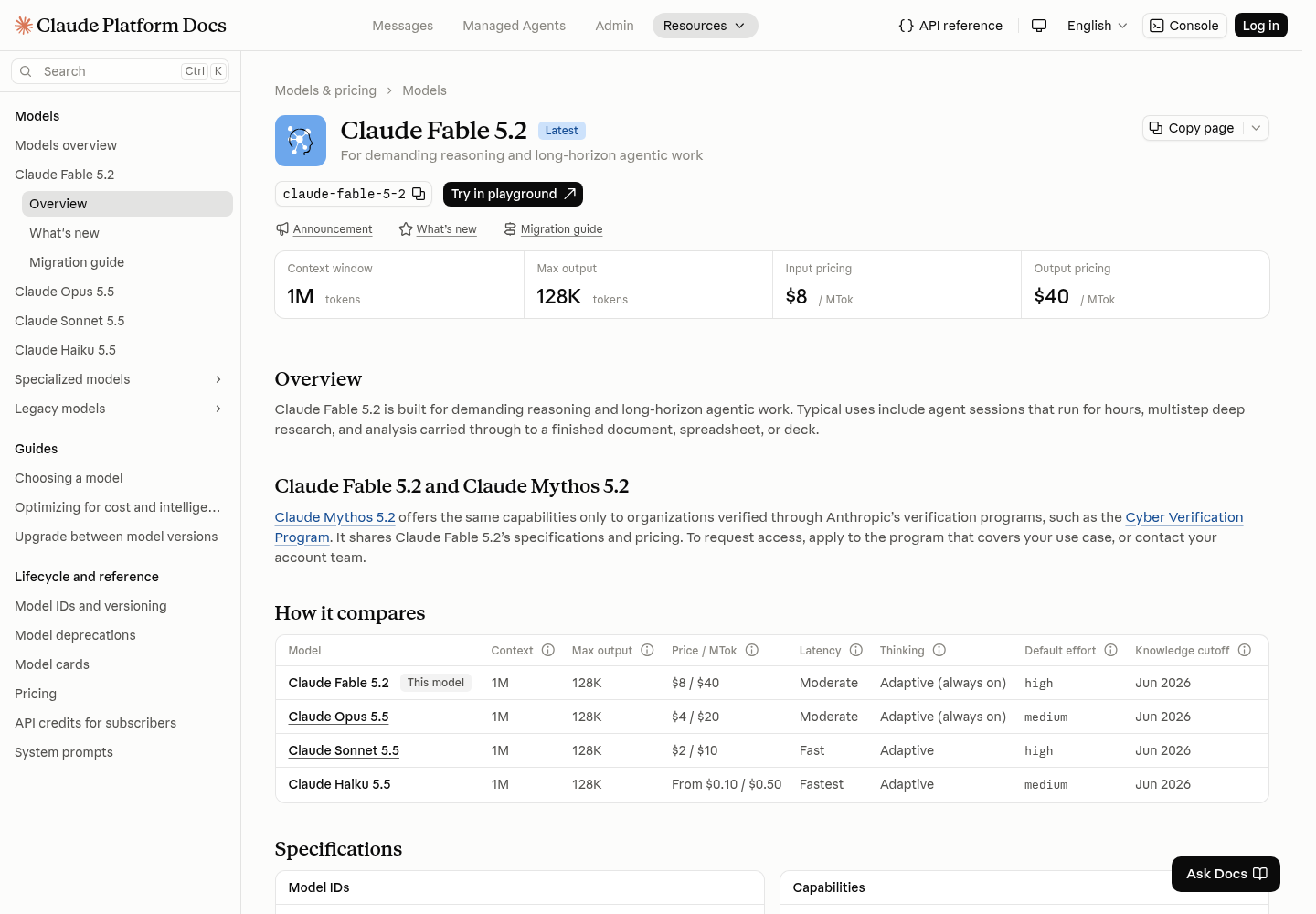
Model specifications and API prices on November 11, 2026. Source.
Progress on demanding tasks
In Anthropic's FrontierCode 2.0 benchmark, Fable 5.2 scored 49.1 percent at xhigh effort. The same announcement reported 45.5 percent for Opus 5.5. At high effort, Fable 5.2 reached 45.3 percent, which Anthropic says cost roughly half as much per task as the Opus run at max effort. These are results reported by Anthropic. Benchmark results and explanation.
I'd take this as a reason to try the model on a difficult task. In my business, that could mean diagnosing an automation bug involving email, a CRM, and data retrieval. A useful answer would need to account for several systems and how information moves between them.
The documentation lists a context window of one million tokens and a maximum output of 128,000 tokens. That allows large amounts of material to fit into a conversation, though someone still has to choose the material. An outdated price list or conflicting instructions remain a problem even when they fit in the context window. Technical specifications.
Choose reasoning effort for the task
Fable 5.2 supports low, medium, high, xhigh, and max effort. The API default is high. According to the announcement, Claude apps and Claude Code default to medium. The same model name can therefore come with different settings. Effort documentation, application defaults.
Anthropic recommends starting demanding work at high and comparing it with medium and xhigh in your own tests. Max is intended for particularly demanding experiments where time and token consumption matter less. Choosing an effort level.
I'd try the same fix with two settings first. If both get it right, I'd compare the time, cost, and review work left for me. One successful answer wouldn't be enough for me to switch every workflow to the new model.
Review instructions written for older models
The Fable 5.2 guidance discusses stopping long tasks before completion, how much work to delegate to subagents, and the effects of older instructions. Anthropic recommends reviewing instructions written for earlier models. In particular, blanket delegation rules or overly strict style rules can create unnecessary work. Model-specific prompting guide.
I find that a more useful starting point than deleting the entire instruction file. The test command or the location of a customer-approved price list is still useful information. Each instruction should have a reason grounded in the work you're asking the model to do.
Compare cost and time in Slopalytics
Slopalytics compares model performance with cost and time per task. It also shows token counts and lets you select reasoning levels. The benchmark view names Artificial Analysis as its data source.
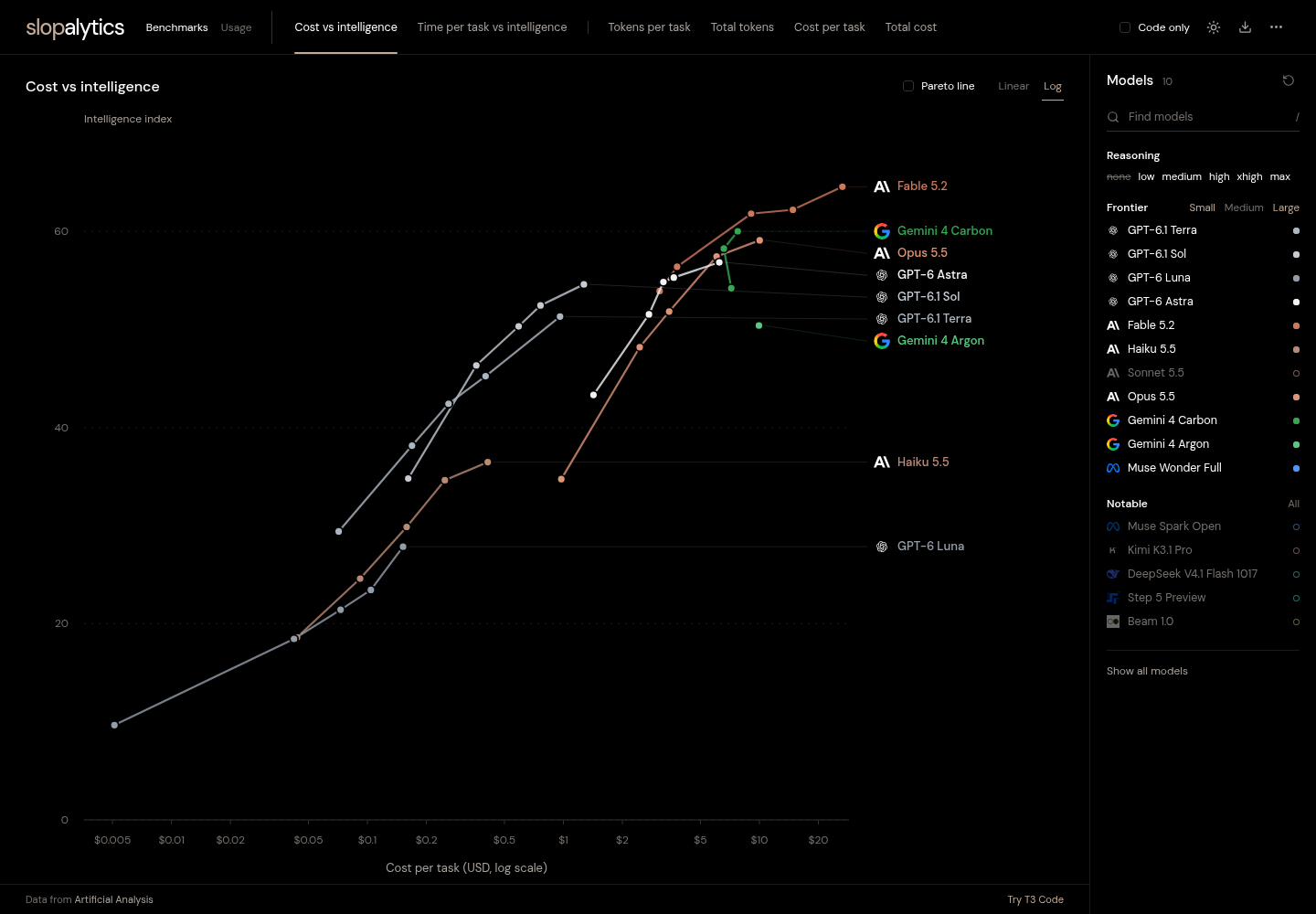
Slopalytics on November 11, 2026. Settings and results may change. Open the comparison.
The charts help narrow down which models to try. I'd still judge a model by the work it produces. Did it find the cause of the bug? Did the quote use the correct price list? Does the report show where its figures came from?
With Fable 5.2, I'd start with a task that takes several rounds of corrections with my current tool. That gives me a practical basis for comparison. I already know what's difficult about the task and what an acceptable result looks like.
Read also: How to start using Fable 5.2 in your work.